
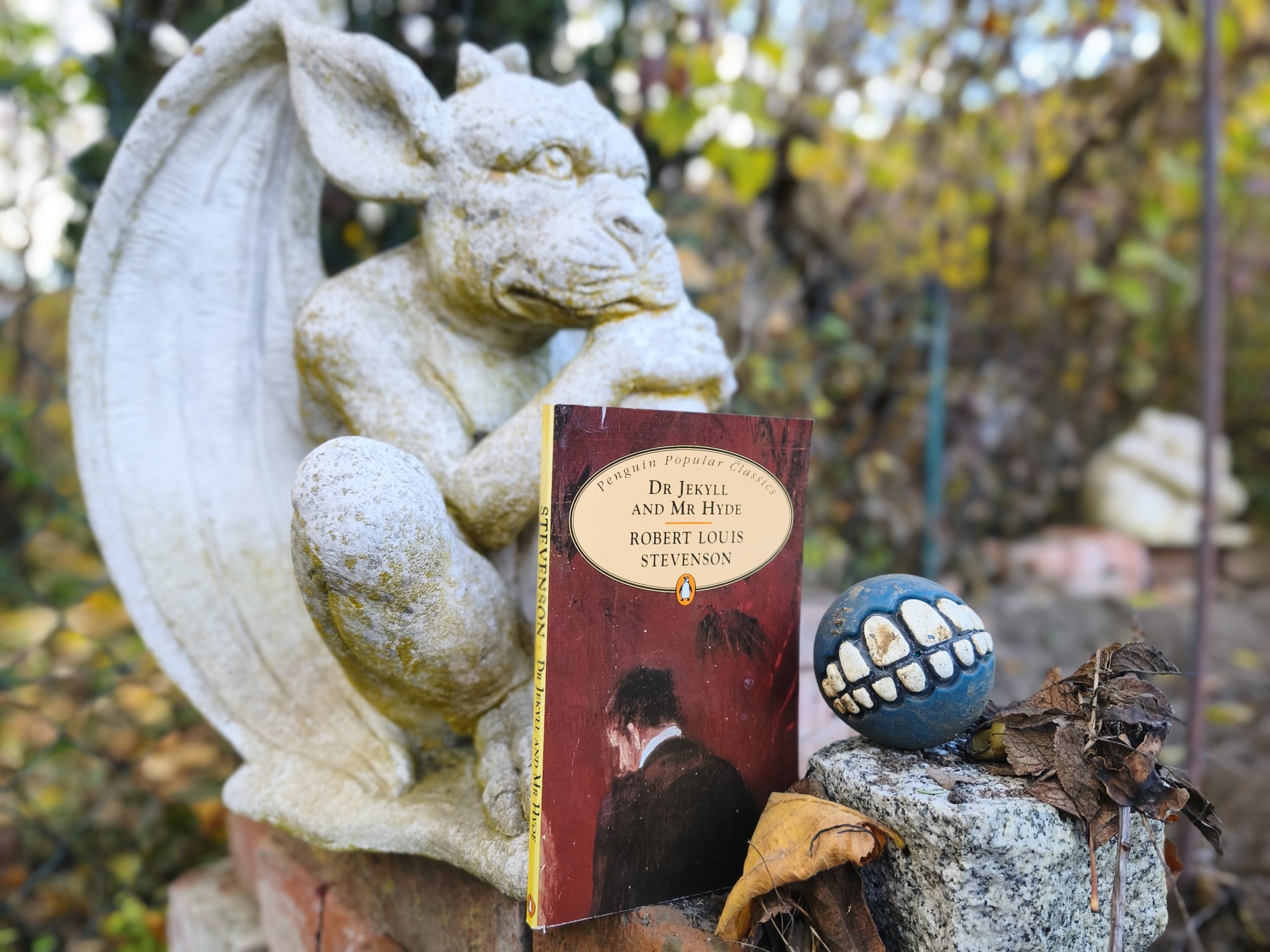
Everyone knows the ending of this one: Dr Jekyll is Mr Hyde and Mr Hyde is Dr Jekyll. But the readers of The Strange Case of Dr. Jekyll and Mr Hyde, published in 1886 by R.L. Stevenson didn’t. They worked their way through a detective-like search for Mr Hyde through the dark and dirty streets of London, through a series of notes, letters and conversations between the very respectable gentlemen populating the novel only to figure out the twist at the end. But reading the story nowadays this is not a twist anymore. That is not to say the story hasn’t got any for the modern reader and maybe I just mentioned them. Like, for example, Mary Shelley’s Frankenstein, published in 1818, the story is told by a person external to our main characters and there is quite the amount of private correspondence which moves the story forward. And there is more to discover under the surface. Yes, Dr Jekyll has a split personality, but who in this novel hasn’t?
not the story you think you know
The story of Dr Jekyll and Mr Hyde is the core of the untiring investigations carried out by the respectable London lawyer Mr Utterson, “the last good influence in the lives of downgoing men”. The story begins when Mr Enfield, Mr Utterson’s cousin, and “well-known man about town”, tells him of a strange occurrence during one of their Sunday walks. The two find themselves on a “by-street in a busy quarter of London”, when Mr Enfield is reminded of having witnessed a man who, on a street corner accident, walked carelessly over a child’s body and left her lying down screaming behind. The story horrified him, but even more horrified was Mr Utterson when learning the name of the culprit: Mr Hyde. For he remembered the name from the will of his client, Dr Jekyll, who would leave his entire fortune to Mr Hyde upon his death, but without confiding to his lawyer as to his relationship to the unknown man.
Mr Enfield’s story disquiets Mr Utterson who, from this point forward, starts acting like a veritable detective in trying to figure out the relationship between Dr Jekyll and Mr Hyde. He contacts Dr Lanyon, one of Dr Jekyll’s old school colleagues, in London’s famous Cavendish Square, “that citadel of medicine”. He talks to Dr Jekyll’s household and his “well-dressed, elderly” butler, Poole. He asks Dr Jekyll himself, who assures his lawyer that “the moment I choose, I can be rid of Mr Hyde”. In parallel, an “aged beautiful gentleman with white hair”, is murdered at the hands of Mr Hyde and Dr Jekyll draws himself further and further into seclusion, behind the closed doors of his medical office, terrifying his household. The story takes darker and darker turns on the background of a London moving from late autumn into a cold and dark winter. We switch from Dr Jekyll’s renowned house to Mr Hyde’s small, hidden, Soho lodge and from cozy gentlemen’s evenings where vintage wine is served to nights of torture and horrific deeds of evil. It is not only the doctor who has two faces, but the story itself, the city, and all these elderly gentlemen, the respectability of whom is a well-kept facade.
The dismal quarter of Soho seen under these changing glimpses, with its muddy ways, and slatternly passengers, and its lamps, which had never been extinguished or had been kindled afresh to combat this mournful reinvasion of darkness, seemed, in the lawyer’s eyes, like a district of some city in a nightmare.
a modern reading of dr jekyll and mr hyde
This foggy and darkness-ridden London is filled with professional and upright men. The credentials of the gentlemen in the story are impeccable. Henry Jekyll signs his will as “M.D., D.C.L., L.L.D., F.R.S., etc.”, the murdered Sir Danvers Carew is a Member of Parliament, Dr Lanyon practises in Cavendish Square, and Mr Utterson is the lawyer everybody trusts. It’s hard to imagine more respectable company. And yet.
Mr Utterson, the moral compass of the story, “drank gin when he was alone, to mortify a taste for vintages” and has not set foot in a theatre for twenty years, although he enjoys it. When he suspects Dr Jekyll of being blackmailed for some youthful sin, his first reflex is to search his own past, “lest by chance some Jack-in-the-Box of an old iniquity should leap to light there”. Mr Enfield tells his story about Mr Hyde on his way home “from some place at the end of the world, about three o’clock of a black winter morning”, and nobody thinks of asking where that place might be. He even has a rule for it: “the more it looks like Queer Street, the less I ask.” “A very good rule, too,” the lawyer agrees. Even Dr Jekyll’s own sins are never named. They remain, in his words, “undignified”, yet take shape in the small, young, figure of Mr Hyde. Mr Hyde is not the exception in this gentleman’s agreement of silence, only its most honest member.
And where are the women? Only two of them have an active role in the story, and neither has a name: the little girl trampled on the street corner and the maid who witnesses the murder of Sir Danvers from her window. One is Mr Hyde’s first known victim, the other his only witness. The other women in the store are passing figures, who belong to the decorum of the story and to the 19th century world which produced it. The screaming women around the trampled child, the housekeeper in Mr Hyde’s house in Soho, Dr Jekyll’s cook and housemaid. The London of the novel is just like we know it, soaking in its darkness and cold, rainy weather, but it shows this time has an unknown face, a city of aged bachelors, without wives, sisters or mothers. It can be done better.
In the end, the mystery of Dr Jekyll and Mr Hyde is solved through two letters, Dr Lanyon’s narrative and Dr Jekyll’s full statement, both read by Mr Utterson behind closed doors. But the story never returns to the lawyer. We never learn what he does with the truth, whether he tells anyone or, more likely, files it away with the rest of the gentlemen’s secrets. Like Dorian Gray, who hid his sins in a portrait, Dr Jekyll believed he could keep his dark self separated from his life out in the open, come back to it and leave it behind whenever he chose to. A modern reader may suspect that the men around him attempted (and succeded?) the very same thing, only without a potion.


your thoughts?