
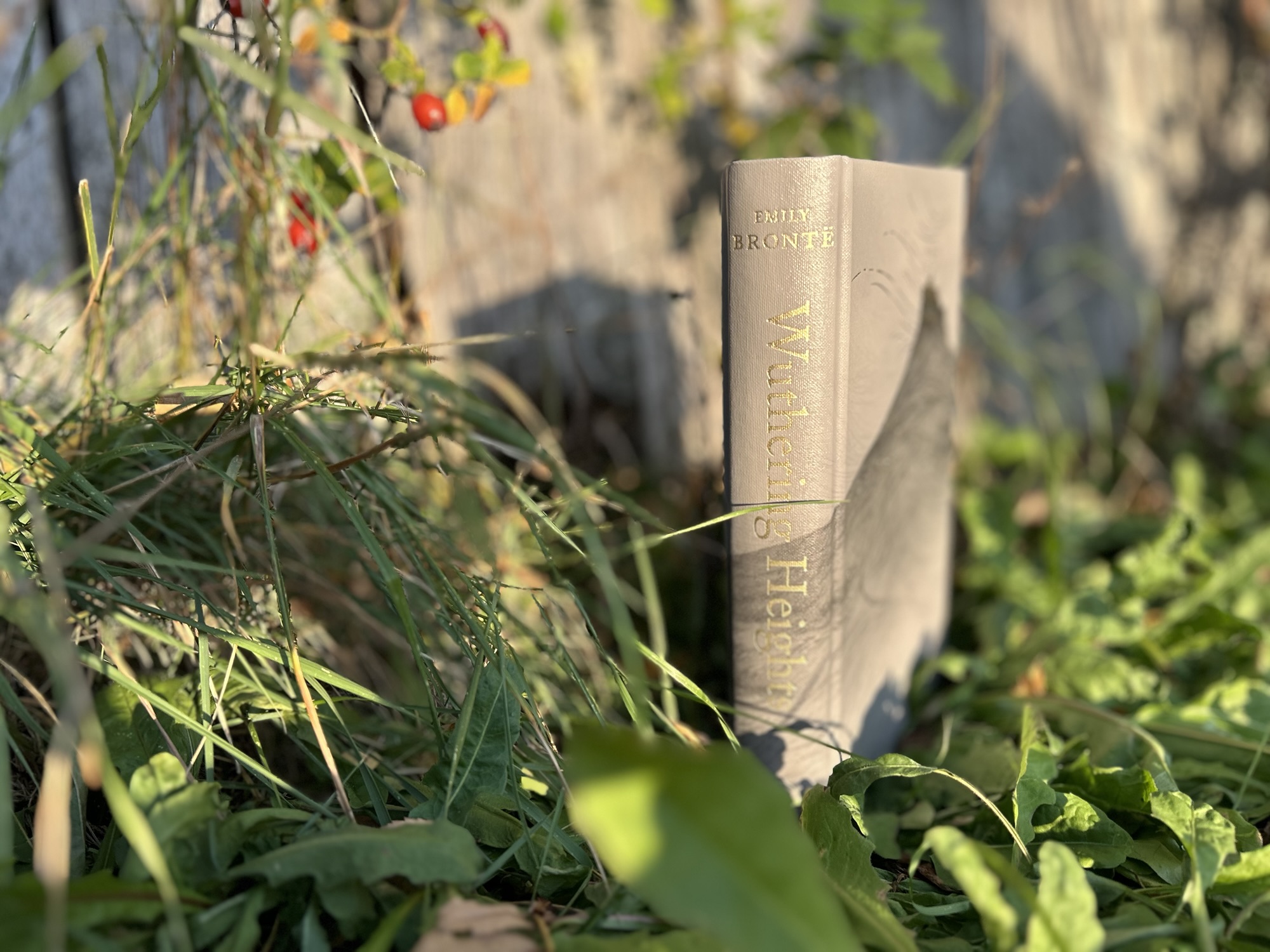
I will not be the first nor the last reader of Wuthering Heights by Emily Brontë to say that this is one damn strange book. Charlotte, Emily’s sister, knew this is how the book would appear to me and many others maybe, readers unfamiliarized with the whereabouts of its author. “Wuthering Heights must appear a rude and strange production”, she writes in the preface of the third edition, published in 1850. “It is rustic all through. It is moorish, and wild, and knotty as a root of heath”. She is certainly not wrong. The book doesn’t reveal its beauty easily, certainly not on a first reading, and not completely even on a fifth. Yes, its difficulty lies in its structure and endless turns and returns in time and space, but also in its language and unlikable characters. What do Catherine and Heathcliff even want from us? Let them haunt each other in their perfect egotism. But maybe that’s not the (actual) point of it. Wuthering Heights is shaped like a novel, but it has the heart of poetry and maybe that’s the key to unlocking it.
reading for the feeling
I used to be one to read with the heart first. I remember one of the first analyses I wrote in school for a text we were studying, trying to convey how much the darkness and moodiness of the text spoke to me. But that’s not what the teacher wanted to have from me. I got red marks all across my paper, minus points, and a good lesson in what we were “really” supposed to write about when making text analysis. That lesson stayed with me until, during my literary studies some years ago, I heard of something called reader-response theory. The foundational text for this theory was written by Wolfgang Iser in 1972 and is called “The reading process: a phenomenological approach”, translated from German. It basically theorizes just how exactly the reader encounters a text: “The convergence of text and reader brings the literary work into existence”, he writes. Me and my book, a match made in heaven. My heaven, namely, because this theory validated my instinctive way of reading, which had got lost in the jungle of the ideologies of highschool literary education.
If one really wanted to, one might actually say that this reader-response theory is nothing if not a structured and institutionalized way of reading which Virginia Woolf brought into being in her essays of the Common Reader and Common Reader Second Series. ‘How Should One Read a Book’ (1926) is indeed an essay published in the second volume, where Woolf talks about free reading, out of the confines of critics and universities, about the power of rereading and the “shape” which a book takes in time. Iser writes, among others, of how the understanding of the book is constructed from successive sentences, how each re-reading creates a background for the understanding of the book, allowing it to “reveal its potential multiplicity of connections”, and the “gaps” in the text which offer space for the reader to insert herself. The two authors have, of course, different approaches to the process of reading, but in the end they both describe the mechanics of how meaning is built in the mind of the reader. And the good news is that it doesn’t necessarily have to do with character analysis.
wuthering heights, a novel for and about readers
Alongside Virginia Woolf’s essays, Wuthering Heights is one of the steps I took on my way back to instinctive reading. Uneducated, free, wild, reading, the kind I did before education tamed it. No wonder Emily Bronte’s novel barred its doors at my first attempt to read it, years ago. My mind was too open and my heart too closed. This is a book you need to read with the heart, like poetry, you need to let its playfulness take hold of you, let its doubling and tripling of people, time and space disorient you till you’re swiped off your feet and you can’t tell up from down anymore. In Iser’s vein, it offers its reader many gaps for her imagination to fill, and, in Woolf’s vein, and reading, as we see below, its strength does not lie in the minute character construction.
The book is a metaphor for reading, both playfully, as well as literally, a method for formal education. It’s full of people reading, of misreadings, and of books traveling from one place to another. The first act of reading in the book happens on the second page, when Lockwood notices the date “1500” and the name “Hareton Earnshaw” above the entrance door. This detail only becomes important at the end of the story, where the past repeats and folds over the present. Lockwood proves himself to be a perfect misreader of the room, making false assumptions about the people in the household at the Heights. Later, when he is forced to spend the night, he reads the many versions of Catherine’s name, and of the Catherines who have slept in the same room.
The ledge, where I placed my candle, had a few mildewed books piled up in one corner; and it was covered with writing scratched on the paint. This writing, however, was nothing but a name repeated in all kinds of characters, large and small – Catherine Earnshaw, here and there varied to Catherine Heathcliff, and then again to Catherine Linton.
Catherine is educated, and tamed, at the Grange, turned into Catherine Linton, while her daughter, Catherine Linton, traces back the steps, and name, of her mother, back to the Heights. Reading has left the Heights together with Catherine the mother and is brought back by Catherine the daughter who builds a relationship with Hareton by teaching him how to read. Education can also be a weapon when used unwisely, as we see in Catherine’s making fun of her cousin’s poor reading skills, but it is in the end the tool and the path the two walk to return to an illuminated life of the mind.
virginia woolf on wuthering heights
The difficulty of Wuthering Heights is not in vain. The turns and returns, the doublings, the circular, claustrophobic, closed space of the Grange and the Heights are meant to bind you down and hold you trapped in this world of wild emotions. The novel is of course, on some level, “about” a lot of things. It’s a novel of obscure origins and social rise, it’s a novel of the Gothic, the macabre and the supernatural, also a novel about the importance and necessity of education, and about the situation of women in the early 19th century. Yet it is also its meaning, which folds over its difficult language, claustrophobic structure and wild wuthering winds of the moors. Virginia Woolf writes in her 1916 essay ‘Jane Eyre and Wuthering Heights’, published later in The Common Reader, about Charlotte and Emily and how this is where the meaning of their books lies:
The seized those aspects of the earth which were most akin to what they themselves felt or imputed to their characters, and so their storms, their moors, their lovely spaces of summer weather are not ornaments applied to decorate a dull page or display the writer’s powers of observation – they carry on the emotion and light up the meaning of the book.
In her essay Woolf reads the two novels alongside each other and shows where the strength of each lies. She calls Jane Eyre “exhilarating”, but it clearly is Wuthering Heights that she feels connected to more. Reading and rereading Emily’s novel over the years brings me closer to Woolf’s understanding of the book, that is the poetry of it which shines through its pages. The novel is an evocation of something primal and wild, which reflects in the strong and strange feelings Catherine and Heathcliff have for each other. They are bound by an otherworldly light, and I’m not sure how much their relationship can be taken at face value, how much should we impute on Catherine that she is selfish for marrying Edgar and how much should we pin Heathcliff against a wall for his actions of revenge. It’s like they are human beings in shape and form, but that’s not really how we should read them. They are more like symbols which carry the ineffable and unspeakable within, rather than realist characters doing realist things in a realist, if fictional, world.
the other side of the coin
The difficulty lies also in marrying these two aspects with each other. I was saying above that the point of the novel is the primordial feelings it evokes, yet it’s undeniable that we are reading a novel, which has characters and a social reality it builds up and sits on. Virginia Woolf sees this, of course, and the end of her essay moves towards reaching an understanding of the novel which integrates the real characters as well. In her opinion, this is where Emily Brontë’s mastery of her skill lies – being able to build a crisp, if unlikeable, reality on top of poetry which might or might not elude the reader’s understanding. For her, the realist setting strengthens the ineffability of poetry and offers the reader characters which, if strange, could very well exist in a world the reader can recognize.
But she was novelist as well as poet. She must take upon herself a more laborious and more ungrateful task. She must face the fact of other existences, grapple with the mechanism of external things, build up, in recognizable shape, farms and houses and report the speeches of men and women who existed independently of herself […] we are given every opportunity of comparing Wuthering Heights with a real farm and Heathcliff with a real man.
If Woolf sees the two aspects of the novel as complementary, I see them rather contradictory. If I am reading the novel as otherworldly and I am willing to allow Heathcliff and Catherine a pass for being such horrible people, does this mean I am disregarding the characters who are affected by their wrongdoings? Doe this mean I put them above morality and common humanity and forgive them just because they are not of this world? They might or might not be recognizable human beings, but they are so alive and this must bound them to the rules we have as society. On the other other hand, does art have a moral responsibility to life? Same question which springs out of The Portrait of Dorian Gray by Oscar Wilde, another baffling novel, yet with an entirely different message. I am and remain haunted by these questions like Heathcliff by Catherine.

Charlotte writes in her preface from 1850 that Emily was too young and inexperienced and, “had she but lived, her mind would of itself have grown like a strong tree, loftier, straighter, wider-spreading”. She sees her sister’s novel as the product of a writer with no control over her characters, but with a creative vision, sometimes not even entirely under her control, which she carved “with simple tools, out of homely materials”. Charlotte offers the reader of the time a sort of excuse for such a morally unsettling story filled with such despicable characters. It’s the moors, she seems to say, it’s not Emily’s fault. And they really must be, I believe, but in a baser and more preternatural way than Charlotte would have us believe. I believe Emily caught a glimpse of the eternal and unperishable in the rhythms of her beloved moors and gave it the shape of people and a novel to better come to terms with it herself. The story might be wild, and the characters repulsive, but nothing less could bring her, and us, closer to that wild heard of the beyond.




your thoughts?