
Over the past years I’ve been finding myself returning to Katherine Mansfield over and over again. Like Virginia Woolf, she has become a pillar of my reading year, always to pick up when spring comes around and April is in full bloom. I’m not sure though why I, or generally we, associate Mansfield’s stories with flowers in bloom. Must be because of the perfect beauty of her style, her signature beginnings and endings, her free indirect speech which melts you with the mind of her characters and makes you realize they, even the worse of them, are just shades of human. In spite, or in tone, with her beautiful writing, she writes much of the darkness of being human. Oppressive marriages, men holding their wives emotionally hostage, fathers keepings their daughters prisoners of home, shady men who might or might not have committed crimes. All this and more can be found in the three short story collections published during her lifetime, the best know of them being today probably The Garden Party and Other Stories, published in 1922. But after her death in 1923, her husband, John Middleton Murry, released two further collections, one of them titled The Doves’ Nest and Other Stories, published just some months after Mansfield’s death.
fragments of the doves’ nest
The Doves’ Nest and Other Stories contains 21 pieces, out of which only 6 are finished stories, the best well-known of these being probably ‘The Fly’ and ‘The Doll’s House’. Murry wrote an introductory note for the volume, explaining which story fragments he chose to print and which he held back for his variant of Mansfield’s Journal, which would be published some years later, in 1927. It is well-known today that Murry’s version of Mansfield is very far from the messy reality of her life. In his introductory note, as well as in the censored Journal he published, we get the image of a genius author, a suffering saint, and a woman of her time.
it has seemed to me that there is not a scrap of her writing—not even the tiniest fragment—during this final period which does not bear the visible impress of her exquisite individuality and her creative power.
Mansfield was certainly a genius, that’s why we still read her today, but later studies showed her true struggles and her rebellious nature. While I am personally grateful to Murry for having released insights into Mansfield’s process of writing, along with her intention to publish certain stories in future volume she never got around to anymore, I am still concerned that we are left to read what he decided to edit in and edit out. Through today’s knowledge it seems somehow that he used Mansfield’s words as a springboard into manufacturing the image of a woman author which herself would make good on an iconic image of woman. The originally published volume has this sentence on its frontispiece, which really makes me laugh out loud
Reverence, that angel of the world

Mansfield was certainly no angel, nor did she intend to be. Reverence was not one of her strong suits either. She was a wild creature, one who did what she and only she chose to do, and unregretfully paid a very early price for it. She left behind many story fragments, her diaries and letters, but she also burnt a fair amount of it. In the story fragments we read in The Doves’ Nest and Other Stories we see, even if through Murry’s editorial hand, mostly her preoccupation with the protected lives of young women and the lies of marriage, themes which reach back to some of her most famous short stories. Her young woman characters live what they believe to be a blissful, happy life, which in the end turn out to be something else entirely.
The best example for this is Mansfield’s well-known ‘Bliss’, published in 1918, during her lifetime. Bertha is engulfed in an almost unspeakable feeling of happiness as she thinks of the evening’s dinner party and the visit of Pearl, a young woman Bertha feels to have a secret connection with. The secret connection turns out however to be between Pearl and Harry, Bertha’s husband, as Bertha’s entire world falls apart. Lies and knowledge are a topic of a short story fragment ‘All Serene’, one of the two stories which were unfinished because, as Mansfield wrote, she talked about them to other people and “they felt betrayed”. Mona and her husband are in “wonderfully good spirits” for breakfast, but the day worsens as they have an argument about whether they should read each other’s letters. There is a hint that the husband has something to hide, but Mona’s own jealousy and fears might be a reality of themselves. Self-deception and truth in a relationship are a favourite topic of Mansfield, as we see in ‘A Dill Pickle’ as well, a hidden gem in itself, published in 1917.
‘The Doves’ Nest’, the story which gives the volume its title, is another one of the many story fragments left behind. When the father of the family dies, his wife and daughter must care for themselves. Things might just take a good turn, as the mother sees it, when a Mr Prodger, a friend of the deceased, pays a visit to the bereaved family. The story reminded me a lot of Henry James’ preoccupations with life and customs in America and England, especially of his 1879 story ‘Daisy Miller’, but Mansfield’s eye rests longer and more intensely on the interior lives of all the women in the house. Milly, the daughter, is pushed by her mother into a relationship with Mr Prodger, something he might himself be after, while death seems just like an excuse to continue living and pursuing one’s own goals.
a world of their own making
Katherine Mansfield stories are very social, often about characters, young and old, making their way through society and the world, while realizing truths about themselves which were for a long time hidden. The stories in The Doves’ Nest and Other Stories are of course no exception. This is less obvious in really short fragments, some only 3 pages long, but more obvious in well-polished stories such as ‘A Cup of Tea’. I already wrote a short summary of what the story is about, and I really encourage you to read it yourself because it really is one of my Mansfield favourites. It is quite similar to ‘Bliss’ in a way, but its ending is much more conclusive, and the path Rosemary decides to take put her in a different light in the eyes of the reader than Bertha. If Bertha is the innocent one, we empathize with and feel a bit sorry for, we take distance from Rosemary and somehow enjoy looking down on her. We are so much better people.
Her heart beat like a heavy bell. Pretty! Lovely! She drew her cheque-book towards her. But no, cheques would be no use, of course. She opened a drawer and took out five pound notes, looked at them, put two back, and holding the tree squeezed in her hand, she went back to her bedroom.
This kind of play between narrator, character and reader is a trademark of Mansfield’s writing, and it really jumps out of the page once you realize it. She works with material details and plays with the shifting point of view offered by the free indirect speech to create several levels of irony. We learn about Rosemary at the beginning of the story that she doesn’t like lilacs because they are “dreadfully shapeless” and she is used to shopkeepers tending to her wishes. This already gets her minus points from the reader, and even more so when her seeming act of kindness to a beggar girl is motivated by the thrill of it and by how her friends would see her. Rosemary lives in her mind the entire story and the only time she snaps out of it is the moment when Philip, her husband remarks on the girl’s beauty. And even then she chooses to get rid of the girl, the disturbing factor, and ask her husband for a nudge back into her dream world: “Philip… am I pretty?” The interesting thing is that the reader can tell of these shifts all along and finds herself playing along with it, being caught in Rosemary’s inner world, while seeing everything from the outside and relating to the characters as well as to themselves. Mansfield’ stories have the power to be really good stories but also an anchor in real life.
literature is not enough
What are we left with, then, after reading the The Doves’ Nest and Other Stories? It is not quite Mansfield’s book. It is a book of fragments put together by Murry’s editorial hand, his “angel of the world” pressed over her unfinished sentences. But somehow, read in the context of Mansfield’s entire oeuvre, the pieces themselves resist that framing. They show glimpses of her finished stories, of women who mistake self-deception for happiness and of households where love and possession are easily mistaken for one another. Murry might have chosen what to print and what to leave out, but Mansfield did know where her unfinished fragments, maybe even her whole literature, were going and she even might have told someone.
There is something wanting in literary art even at its highest. Literature is not enough […] the greatest literature of all—the literature that scarcely exists—has not merely an aesthetic object, not merely a didactic object, but, in addition, a creative object: that of subjecting its readers to a real and at the same time illuminating experience.
In his account of their last conversations at Fontainebleau, A. R. Orage, Mansfield’s editor, friend and former lover, talks about the author describing a “new attitude” towards writing, which she had found in the months before her death. She had the wish to stop being a “selective camera” recording marriages and people from a passive distance, and instead to write toward something closer to what she called “an initiation into truth”. She wished to write something more than great literature, she wished to infuse her writing with creative power and come out on the other side with a “creative object”, which, as I understand it, might stir something real in the heart and mind of its readers. The example she gave Orage of a story she might write was a marriage haunted by old affairs, “ghosts” both partners wanted laid to rest. It’s like she was imagining the same women and the same rooms she had already written about, but met with courage instead of irony, with an empathy which might bring them closer to them being really understood by the reader. Murry left us fragments of the writer she had been. What Orage left us is a glimpse of the writer she was only just becoming.
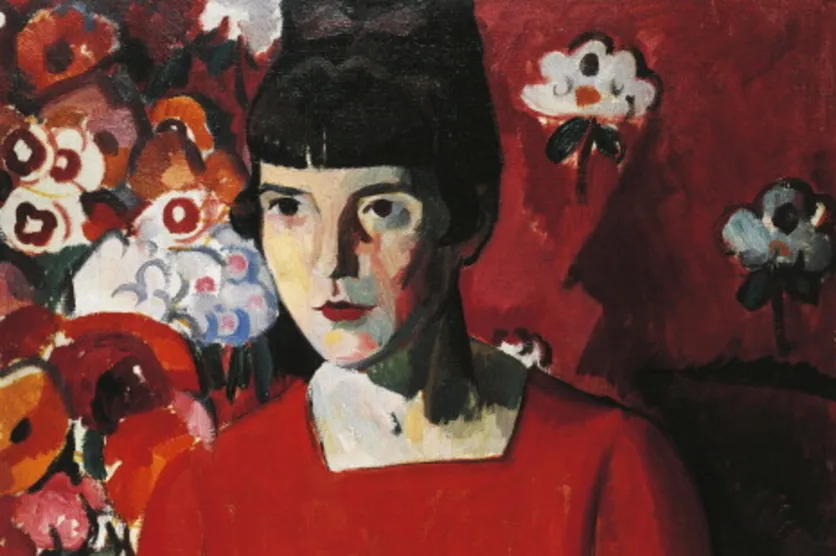
Katherine Mansfield’s portrait is a 1918 oil painting by Anne Estelle Rice.



your thoughts?