
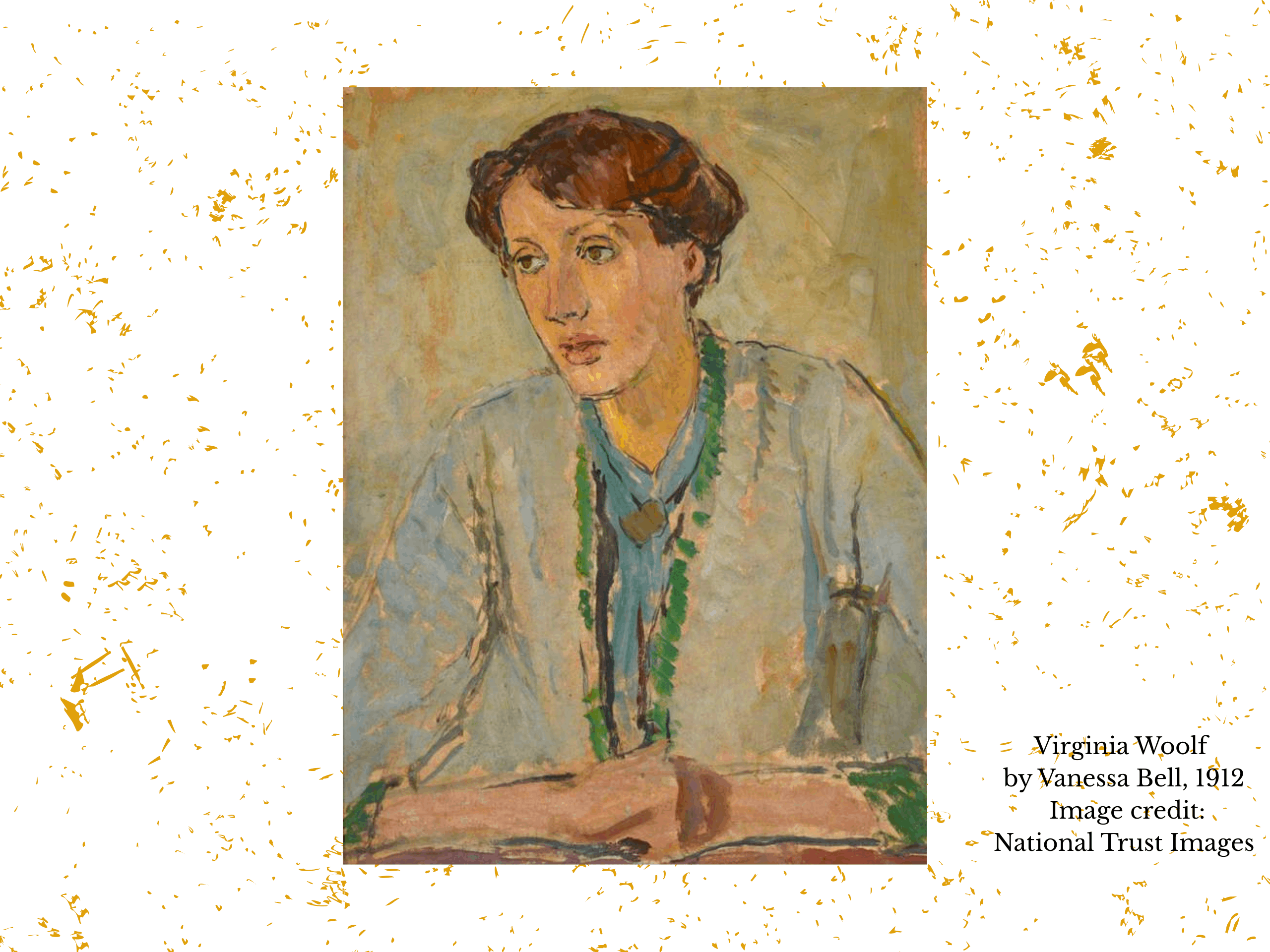
I’ve spent the last few years reading and re-reading Virginia Woolf, doing courses in Cambridge, walking the Mrs Dalloway route in London, and writing about her books on this blog. It’s easy for me to forget that maybe there are still people out there who haven’t yet known the joy of reading Woolf, so this post is all about not forgetting that (even for me) there is always a beginning. There is always a first step, the first overcoming of fear and intimidation, the first pang of recognizing the freshness of present day in Woolf’s 100-year old words. So in this post I’m putting together a path of discovery for readers out there who are still new to Virginia Woolf. I will give you a short overview of her biography with focus on elements which shape her writing, I will reveal her experiments in fiction, and I will suggest where and how to start reading her, the author who is one of the most widely recognized names of English literature.

a very brief life of Virginia Woolf
Hermione Lee starts her biography of Virginia Woolf by wondering how can one even hope to encapsulate a person in their biography. Is it even possible? I want to extend this question and ask what we are actually looking for, as readers, when reading the biography of a favourite author. Is it just about knowing the facts of where and when they were born, how their childhood was like and what elements they poured in their novels (consciously or otherwise)? Or is it about seeking the very essence of their writing in some big or small elements of their life, as the biographer saw fit to publish it? In my very brief micro-overview of Woolf’s life I will not attempt any of these. That’s something each reader needs to answer for herself. But I will try to show that her modernism is very Victorian, one might even say realist almost.
Virginia Woolf has not always been Virginia Woolf. She was born in London in 1882 as Virginia Stephen, daughter of Leslie and Julia, both very successful products of the Victorian age. He, a man of letters, historian, critic and editor, and she, a beautiful woman concerned with her children and her charity work. In the spirit of the Victorian age, Leslie decided to give Virginia an education at home and, additionally, free rein of his well-stocked library. The limits of the private household contrasted with the intellectual freedom Woolf enjoyed and shaped her later political thought, most famously in A Room of One’s Own (1929), but would also shape her fiction, most obviously in Night and Day (1919). The family spent summers at St Ives in Cornwall, a place that left its marks on Woolf throughout her life and later inspired the setting of To the Lighthouse (1927), with her parents being the real-life models for Mr and Mrs Ramsay. The deaths of her mother in 1895, her half-sister Stella two years later, and her father in 1904 left lasting marks on her wellbeing and contributed to periods of mental illness that would accompany her for much of her adulthood.
After her father’s death, Virginia and her siblings left the family home in Kensington and moved to the Bloomsbury district of London. The move marked a break from the values of the Victorian world in which they had been raised, and became a meeting place for writers and artists who would later be known as the Bloomsbury Group. In this circle, Woolf found people that encouraged her in her writing and her uprising against the values she had herself been raised in. Woolf was born into the final decades of the 19th century and would become one of the defining voices of literary modernism, with much of her work reflecting the tension between two worlds. In one way, it could not have been any different. Her novels are often critical, yet fond and nostalgic, of Victorian values, while searching for ways of understanding identity, memory, time, and human relationships which fit to the new century. In her plots she turns inward, exploring the flow of consciousness and the private experiences that shape a life. In many ways, Woolf’s fiction can be read as an ongoing conversation between the Victorian world that formed her and the modern world she transitioned into.

good stories and experiments in fiction
I’m actually not sure how readers new to Virginia Woolf approach her. Are you afraid? Intimidated? Curious? You probably need to be all of this and more if you’re planning to pick up her writing. She is such a revered figure of modernism, feminism and women’s suffrage that it’s almost impossible to come to her without some sort of pre-existing cultural baggage. Yet at the same time she is so easy to flow with, so close and so funny and engaging. The novels which make up what I called her trilogy – Mrs Dalloway (1925), To the Lighthouse (1927) and The Waves (1931) – are three short novels that follow quite recognisable stories and real, concrete characters, even as they experiment with how those stories are told and how character in fiction is build
Mrs Dalloway takes place over a single June day in 1920s London and follows Clarissa Dalloway, an upper-class woman preparing for a party, as her thoughts drift between the present and memories of youth. In a parallel thread we meet Septimus Warren Smith, a traumatised war veteran whose fate overshadows Clarissa’s celebration that evening. But this is no 19th century realism. Woolf lets a kind of “general consciousness” pour through all characters, be they major, such as Clarissa and Septimus, or minor, such as Mrs Dempster who sits on a bench in the park looking at Septimus and his wife, as the novel and the much-awaited party expand into something like a shared, common life.
In To the Lighthouse, the central “plot” is even simpler. Mr and Mrs Ramsay, their eight children and several guests spend a summer at a holiday house in the Hebrides, and a planned boat trip to the lighthouse is first promised, then postponed, and finally undertaken years later, after war and loss have changed the household. The novel lives in the minutely examined interactions between the characters, while touching on irresolvable topics such as the relationship between children and parents, but also on the endlessly rich inner life of women trying to find their place in a changing world.
The Waves, often called Woolf’s most experimental novel, traces six friends, Bernard, Susan, Rhoda, Neville, Jinny and Louis, from childhood to old age entirely through their spoken monologues, yet across this very experimental form of direct speech you can still follow the shape of their intertwined lives: schooldays, work, love affairs, grief for a dead friend. But don’t let yourself be fooled by my simple explanation. The Waves is an experiment of the limits of language, and ends a trilogy which seems bent on breaking down traditional narrative techniques while building on its very scaffoldings.
Virginia Stephen became the Virginia Woolf we know today because of her late-Victorian education, because she sensed the changing tides of her time, and especially because she was an astonishing reader. She believed, and, as we see today, rightly so, that self-taught reading would give her the education which the fashion of the time denied her and the others of her sex. She devoured her father’s library, contemporary fiction, works of science and philosophy and made herself be what she encouraged everyone to become: a common reader. This passion is most visible in the more than 600 essays she wrote along her lifetime, but of which she only published two collections: The Common Reader (1925) and The Common Reader Second Series (1932). The essays are studies in reading, slowly changing from historical reading to a contemporary and political position which she grew more and more into, most visibly in the 1930s. Three Guineas (1938) is her book-length essay which, as I see it, is the pinnacle of her political writing and cultural thinking. She does many things in this essay, but, most incisively, she takes old words (patriotism, honour, education) and wears them and cracks them open until women, that disregarded and most disadvantaged of the sexes, can occupy them without surrendering their lives on an altar of words not belonging to them.
I’ve been reading Woolf’s novels, essays, letters and diaries for some years now and one thing is becoming clearer and clearer: Virginia Woolf is, contrary to what one might believe, not sacrificing story for art. The single day in London, the postponed lighthouse trip, the six lives told in waves of speech, the imaginary sisters and daughters in her essays all belong to the same project of asking what kind of language could hold life without flattening it.

where to start with virginia woolf
If you’re looking for ideas on how and where to start exploring the world of Virginia Woolf, you might as well stop. Pretty much anyone will tell you to start with Mrs Dalloway, her modernist masterpiece, and I will not contradict them. It is a good starting point, but there’s more than one way to go about it.
a sense of place – for the reader who loves atmosphere and the feeling of being inside a book
There is indeed no better recommendation for you but Mrs Dalloway, but don’t jump right to it. If possible, start with my guide on the Mrs Dalloway London Walk as a first introduction to how Woolf builds a novel out of streets and sounds. Then read the actual book. You will hear the novel differently once you know how Big Ben, the aeroplanes, and the old woman singing do the structural work usually lifted by the plot. Woolf is great at walking and breathing in space. The quintessential essay where she writes about walking and reading is ‘Street Haunting: A London Adventure’ (1930). The parallel with Clarissa buying flowers herself on that June morning is unmissable. The errand of buying flowers, pens, what have you, is a pretext, the walk is the goal. If you want even more of London, make sure you check a collection of 6 essays on the London life, called The London Scene, published in 1975. Here, Woolf walks her readers through the Docks, Oxford Street, the great houses, Westminster Abbey, and the House of Commons, turning from the inward and philosophical to the outward and observational.
woolf as reader – for the common reader in you
This pathway starts where most Woolf guides never send you, with The Common Reader, Woolf’s hand-picked collection of essays on the joys of reading, where we discover a different Woolf that the one we all tend to carry in our cultural baggage. She is a self-educated, thrills-driven reader much live yourself maybe. Then visit the post on books and reading in Virginia Woolf’s essays, which maps the broader landscape of her critical writing. You might then want to pick up the famous Mrs Dalloway, having an advantage on your side: knowing how she thought and what she was listening for, both in her reading and her writing.
reader of life – for the reader looking to walk the biographical route
Begin where most readers never think to begin, with A Sketch of the Past, the memoir-diary Woolf wrote in fragments between 1939 and 1941. In it she describes her early memories of light and sound at St Ives and her mother’s presence as something barely articulable. From there, go back to To the Lighthouse (1927) and read it as the fictional version of exactly what A Sketch of the Past is attempting in memoir form. Woolf wrote in her diary that finishing the novel allowed her to stop being obsessed by her mother, and that in fictionalising her she had laid her ghost to rest, but that’s not the final image of her mother, and not even a “real” one. It’s only later, as life and experience matures her, that Woolf has the creative capacity to revisit her memories. As a shaking out of the elegiac form, you might end this path with Orlando, the mock-biography of a character who lives from the Elizabethan age to 1928 and changes sex midway, published a year after To the Lighthouse. Where To the Lighthouse is Woolf writing about loss and the dead, Orlando is Woolf writing about love and the living, two very different attempts to capture a real person on the page without reducing them to a character.
…and beyond
Virginia Woolf was a prolific writer of novels, short stories, essays, letters and diaries and in my short overview I can’t even hope to get across the multiplicities which pour from her writings. If this blog post has cracked open a door and you want to go further in your explorations, there are a handful of online spaces worth knowing about. These things are made for readers who, like me, are open to what the writing for Virginia Woolf has to offer.
Woolf in the World, the Substack by Dr Karina Jakubowicz is one of the single best ongoing resources. She writes on Woolf and Bloomsbury with warmth and without jargon. Her companion podcast, The Virginia Woolf Podcast, made in association with Literature Cambridge, brings in writers and artists whose work Woolf has shaped in unexpected ways. For a more personal, long-running reading log, Blogging Woolf by Paula Maggio has been tracking Woolf news, events, and discoveries for over thirteen years. And if, despite all, you’re still wondering why you should pick up Virginia Woolf at all, give this Ted-Ed video a shot.


your thoughts?