

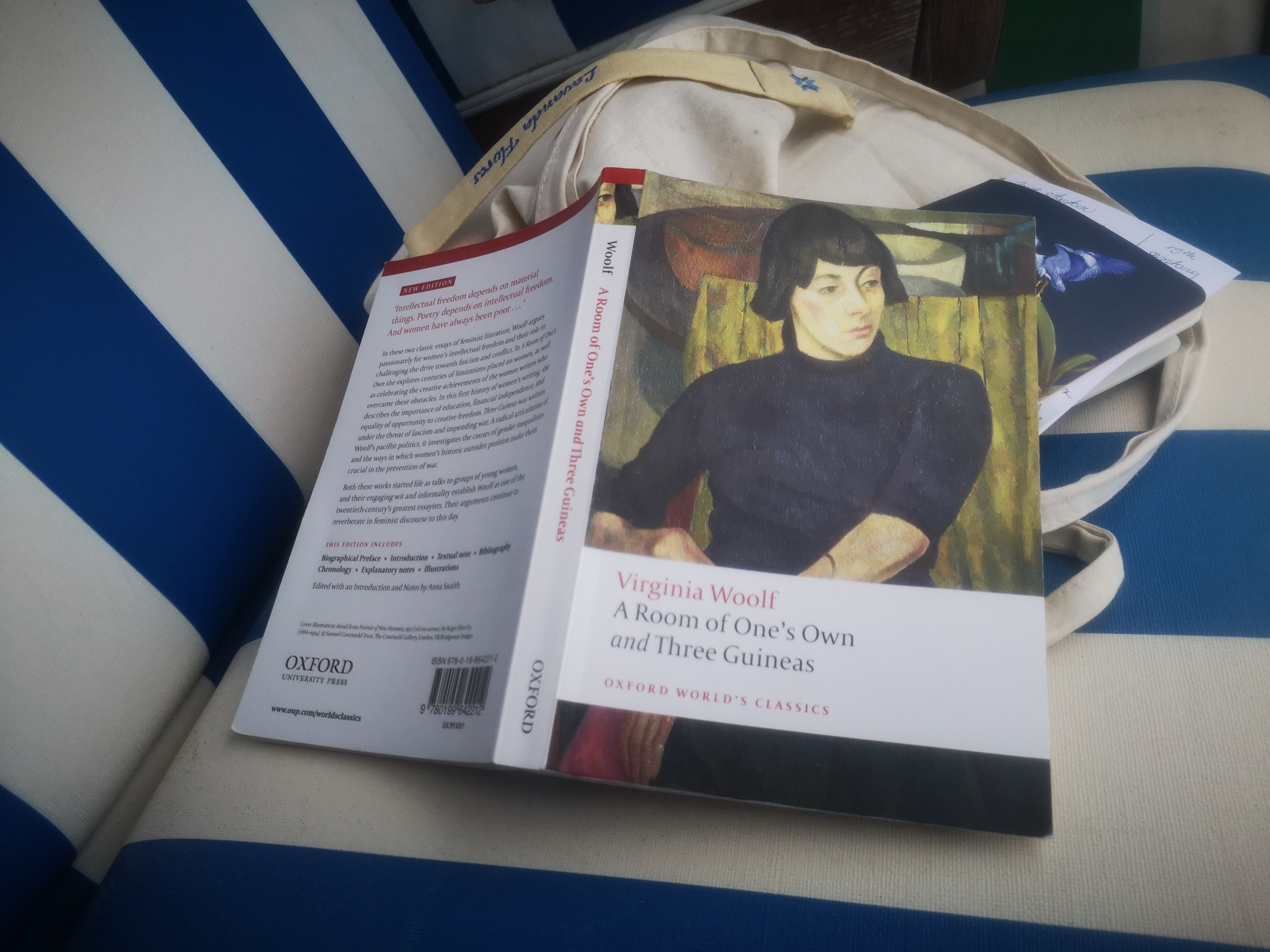
I will not be the only reader of Three Guineas by Virginia Woolf to say that this… text (?) does not compare to anything I read before, neither by Virginia Woolf herself, nor by any other writer. Three Guineas is such an intricate web of non-fiction, fiction, essay, letter-writing, argumentation and a score of other nameable and non-nameable genres of literature, that it’s difficult to put a single label on it. Calling it a “book-length essay” would tame its wildness and prickliness. Text, a word popularized by literary theory and applied to virtually anything written down, seems, within its limits, the best word I can use to somehow pin down Woolf’s monstruous brainchild. For it is indeed a monster of research, as much as it is an innocent child of utopian imagination. It is something woven, stitched from many voices, quotations and photographs, a fabric of thought, as well as a clear arrow into a bright futuristic sky, a creature of language, in which old words are taken apart and reassembled so that women might finally use them as their own.
the framework of three guineas
Virginia Woolf worked on what would become Three Guineas over several years. She had published A Room of One’s Own, her essay and history of women’s writing, in 1928, and by 1931 she was thinking of “an entire new book, a sequel to A Room of One’s Own”, as she wrote in her diary. This sequel would first take the form of an essay called ‘Professions for Women’, where she encouraged women to pursue creative work by turning against centuries of domestic work, and then a novel-essay, first titled The Pargiters. This novel would then be split into the actual novel The Years, published in 1937, and the essay Three Guineas, published in 1938.
“Three years is a long time to leave a letter unanswered”, the narrator (or letter-writer) of Three Guineas begins, in a very typical Virginia Woolf essay-writing. It’s like we’ve already missed something, so we shouldn’t be too bothered if there’s a lot we will not understand over the following 50 pages or so. At least on a first reading. Three Guineas, is, like Room, very conversational, and moving between voices and spaces. The narratorial voice is a woman who writes a letter responding to an “educated gentleman”, who asked her “how in her opinion are we to prevent war”. Starting from this question Woolf’s narrator goes down on what to the reader only later becomes a clear path of historical, political and religious ideologies which seem to have been built such as to keep women out of the political life and in the private household. In this one letter, which actually includes two more letters, a conversation with a “daughter of an educated gentleman”, five pictures shown in the book, and more pictures not in the book but in the newspapers of the day, the letter writer shows how women paid for the education of their brothers, how marriage was the only profession available to women for a long time, but also experimental (utopian?) ideas of how to carve a new path in the future where men and women work together to prevent war and fight the looming shadow of fascism.

three letters, three guineas, many digressions
The text we hold in our hands is confusing. That’s for certain. It has three parts, but the three parts don’t neatly correspond to the three letters. The first pages are the introduction to a framing letter, to the barrister asking how in the narrator’s opinion is war to be prevented, then comes the first letter, the second letter and finally in the third part can the narrator sum up the answer she had been laboriously working towards and finish the original letter. Only about 10 pages in we do learn, partly, what the barrister wanted from our narrator in the first place. Of course, he wanted her opinion regarding prevention of war, but also:
Let us concentrate upon the practical suggestions which you bring forward for our consideration. There are three of them. The first is to sign a letter to the newspapers; the second is to join a certain society; the third is to subscribe to its funds. Nothing on the face of it could sound simpler.
This is his suggestion as to how war is to be prevented. Not so fast, says our narrator, and she does indeed take pages and pages to build up a more extensive response, one which indeed was 7 years in the making. And she needs time and space in order to make one thing clear: “though we look at the same things, we see them differently”. Men had enjoyed over hundreds of years a paid-for education, while their sisters were given an allowance, as the narrator shows using the 18th and 19th century-letters and biographies she reads. Women had an unpaid-for education, the education of the private household, which would prepare them for marriage, but not for studying for a profession and earn money of their own. Men seem to understand war as a proof of their patriotism, but, our narrator wonders, what does patriotism even mean for women who have been kept out of public life for hundreds of years. Family and home?
These are just some ideas to which the narrator turns back in the third part, and strengthens them with further arguments, built as two more letters. The first letter comes from the treasurer of a women’s college asking for donation to rebuild the college. But before giving her guinea, the narrator wonders what good was education of men in preventing war, and what kind of education do women need in order to actually prevent war. Her ideas are absolutely wonderful:
It must be an experimental college, an adventurous college. Let it be built on lines of its own. It must be built not of carved stone and stained glass, but of some cheap, easily combustible material which does not hoard dust and perpetrate traditions. Do not have chapels. Do not have museums and libraries with chained books and first editions under glass cases
She imagines a revolution of education and freedom from dusty traditions which have brought society to the point of fascism and war. It’s doubtful, she thinks, if education as is will help women fight war, but it is better that the alternative of keeping them in the private household. The guinea is donated, and the letter-writer moves to the second letter, from another treasurer, this time from a society requiring donations to help women enter the professions. The second guinea doesn’t leave the hands of the narrator so quickly either. She moves in a satirical interlude, where she wonders why women are still asking for money if they are allowed to vote and hold jobs and property for 20 years. Again, returning to 19th century-biographies, she makes the case of how earning money influences the life of the professional men, whose work “for God and empire” turns him into “a cripple in the cave”. But if women are to earn money, they need to put it to use differently. Poverty, chastity and derision, words which have defined women’s lives so far must be redefined and given new strength to help them lead new lives, where they can earn money for their work. And the second guinea will go out only if women can earn money and keep their heads up:
For if you agree to these terms you can join the professions and remain uncontaminated by them; you can rid them of their possessiveness, their jealousy, their pugnacity, their greed. You can use them to have a mind of your own and a will of your own. And you can use that mind and will to abolish the inhumanity, the beastliness, the horror, the folly of war.
Now, after two guineas have been donated, can the narrator return to the requests of the barrister and see if she can donate him the third guinea for his society. She does of course decide to donate it, for the funds of barrister’s society are funds for peace, but she will not become a member. She and women generally, are to have their own society, Society of Outsiders, which stays out of any country, will not pick up arms and will not accept any honours or prizes. Women have been excluded from all of these, so now they make the decision to keep away freely and willingly.
conversation as argument
The arguments which Woolf brings in the essay range from “obvious” ones, such as the fact that women were longing to be part of public life as they were excluded from it, to more radical ones, which find grounding even in today’s feminist discourse. Yet the book is never only a chain of reasons. Alongside the “objective” arguments run veins of satire, mimicry, and outright fiction, the kinds of literary devices that, as a devoted reader of novels, I found myself savouring as much as any political point.
One of my favourite moments in the text is in part three, an imagined conversation the letter-writer has with a “daughter of an educated man”. Such daughters are the audience for which Woolf wrote the essay and for which she held the lectures which would later turn into A Room of One’s Own. They are women who come from middle-class families, whose fathers and brothers were educated at the public schools, and whose fate had otherwise been marriage. But now they have the right to vote and hold property, but how are they to manage these rights in order to prevent looming war? One way to do this, the narrator says, is to promote “disinterested culture”, and, in a conversation with such a woman she explains what she means by the term. The woman has several newspapers on her table and is aware that she must search the truth by herself in the press which supposedly presents facts. The narrator tells her that reading is also abstinence, distance from papers who write for money, and her decision where her sympathy and money will go must be bound with her desire to seek and speak the truth. In this intimate conversation, the daughter’s clear voice and knowledge of the world shows how, even from the margins, women can read symbols and begin to imagine another way of being in public life.
old words, new meanings
What really kept me glued to reading Three Guineas through to the end, despite its difficulty, was that it was so typical of Virginia Woolf essay-writing, so steeped in 18th and 19th century biographies and letters which Woolf grew up with in the Stephen house, when she was still a “daughter of an educated man”. It seemed to me that, even if in this new phase of her writing she is letting go of the poetical modernism of To the Lighthouse and irreverential satire of Orlando, the essay is still built on that background of flowing fiction and surprisingly delightful double-edged argumentation which define her previous writing. She has that voice that slides from quotation to reality, from innocent joke to public indictment, and that makes even the driest political point feel like part of an ongoing, intimate conversation with the reader. I think she manages that by speaking a modern language, which echoes to us 100 years later, full of words which still ring true nowadays, when theoretically women (in the Western world at least) have all the rights and privileges they mothers had fought for 100 years ago.
In A Room of One’s Own Woolf was arguing that women are poor and if they only had money and a room to write, they could unleash their creative power. In Three Guineas, 10 years after Room, she notices that asking for things doesn’t mean getting things, and leads a revolution of the Outsiders, with words and concepts which have always belonged to women’s lives. But now, instead of changing the materiality of the world, she is changing the materiality of the consciousness by coming to grips with the world as a given. Poverty, chastity and derision are familiar teachers to the women stepping into the professional lives and they should stay such, because “we have no time to coin new words, greatly though the language is in need of them”. She proposes a deliberate and free life of the mind, with “enough money to live upon… refusing to sell your brain for the sake of money… refusing all methods of advertising merit”. This is the only way the letter-writer sees to prevent war and prevent women of falling down the traps of corruption the traditional system of education and profession has set up for the men.
I really think Three Guineas benefits most from being read in dialogue with A Room of One’s Own. Room can be read as a transitioning phase from Woolf’s creative-oriented thinking towards politics and women’s place in society, while Three Guineas is a full-blown political essay which dives deep into the whys and hows of women’s standing. The earlier essay gives us the formula (money, space, and access to education as the preconditions of women’s intellectual life) while the later essay investigates what happened as those newly educated women stepped out into a world drifting toward fascism and war. When read together, money and rooms shift into the material basis for the Society of Outsiders, into the power to refuse patriarchal dominance and the will to really own what was before poverty, chastity and derision.



your thoughts?