

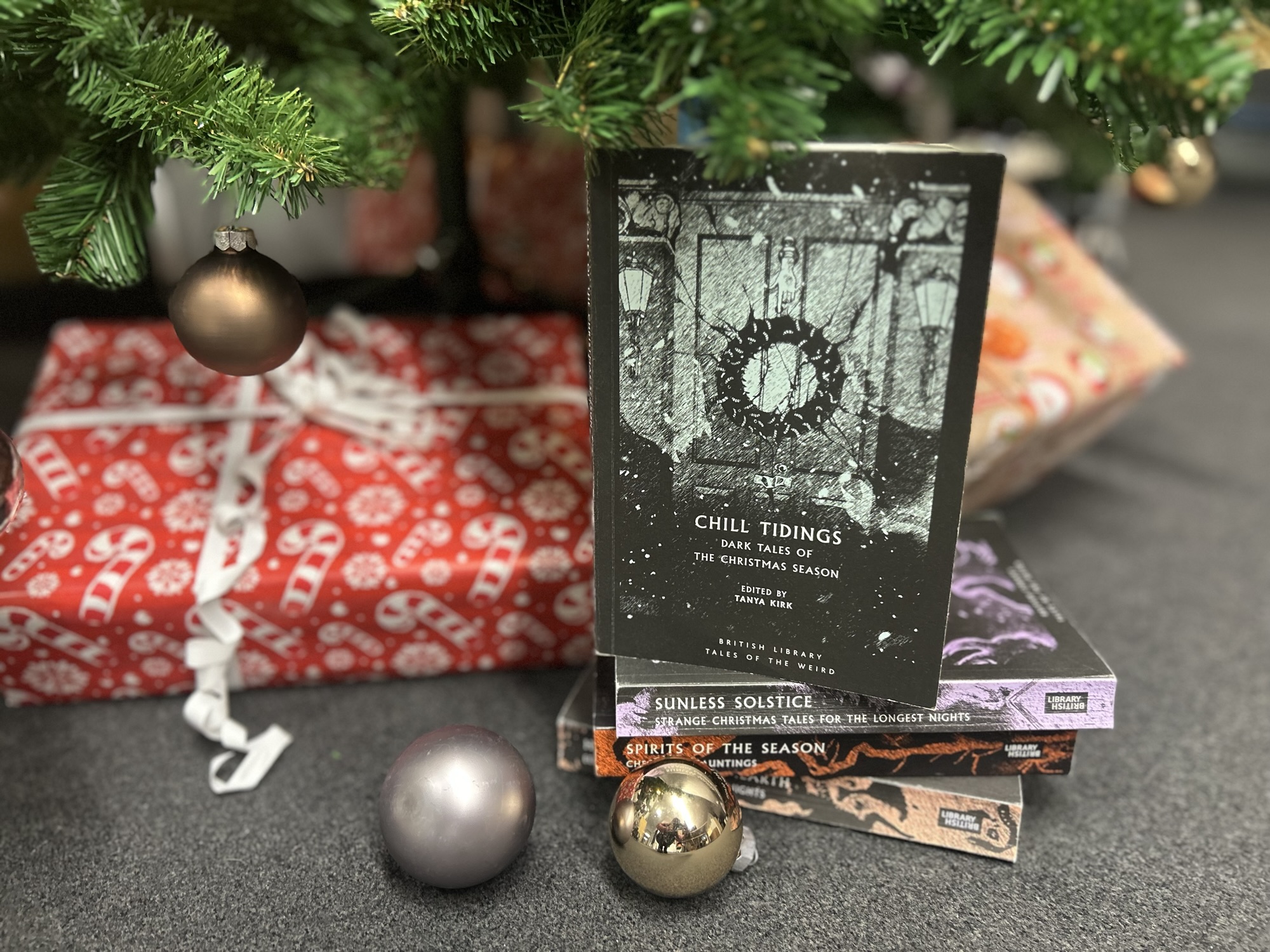
Chill Tidings was published in 2020 by the British Library and, like the previous collections I reviewed, Haunters at the Hearth and Sunless Solstice, it gathers some of the best Christmas stories with ghosts from the archives of the British Library. The stories range from old-fashioned Victorian tales, where ghosts of the past haunt the halls of the present, to modern 20th century tales, where it’s the ghost of oneself that one needs to tame and reckon with. Reading these collections over the years, also in the general context of ghost stories, you start noticing that classic Christmas hauntings tend to follow a few recognizable patterns. There’s always someone of more or less credibility saying they saw a ghost, ghosts generally live in a pocket of time, broken off from the common timeline, and many hauntings live their fullest in the dark corners of the reader’s imagination.
tropes of ghost stories – with or without christmas
Many classic Christmas ghost stories are told in the first person or presented as a story shared within a group. Someone either tells the tale of a ghostly occurrence they survived without themselves knowing how or they heard the story from someone they know, but who didn’t live to tell the tale. This creates distance between the event and the reader, or the listener, as if the narrator is recalling something they still struggle to come to terms with or they have accepted its unknowable nature. The telling itself is a very important part of the whole setup. We read these stories nowadays, but in the old days they would actually be told to a group of listeners, who would have let themselves be swept up by the atmosphere and led into a pocket of time of their own. The best example I can think of is The Turn of the Screw, the very haunting 1898 novella of Henry James, even if it’s not exactly a Christmas tale in itself.
Many ghosts do not react to the living, nor do they seek revenge. They rather go through endless cycles of repeating what once happened to them. They exist like a loop, unaware that anyone can see them, and the haunting comes from witnessing a past moment that refuses to end. ‘The Moonlit Road’, one of my favourite stories by Ambrose Bierce, is a good example which comes to mind right now. The story was first published in 1893 and is more psychological than mechanical in its repetitive cycle. A son who lost his mother relives her murder through dreams and imagination, and the crime is reenacted in his mind. There are some hauntings happening too, though they are something else than you might expect.
Instead of describing the ghost or its actions directly, there are stories which suggest an event through fragments, reactions, or incomplete accounts, either told, written or drawn. What matters is what remains unseen and impossible to explain and recover. H. P. Lovecraft is best known for this technique, allowing the reader to fill the gaps with something worse than any explicit detail. His stories don’t necessarily focus on “common” spectral presences, but rather on very material monsters from beliefs pre-dating Christianity or from beyond the limits of space and time. The events and the unclear way he writes about them are so remote from anything we are used to when thinking of ghost stories and that’s what makes them so scary.
‘the fourth wall’ (1915) by a.m. burrage
This room is just like a scene on the stage. Try and imagine the wall over there – the fourth wall I think it’s called – has been taken down. On the floor is a row of footlights. Beyond it’s all dark, and there is row after row of blurred faces.
Classic ghost stories care little about the people in the stories and this is a perfect example of this. The story is told by the husband of Mrs. Marriott, a character who is very much at the edge of the events in the tale. If it hadn’t been for his wife, Jack’s sister, whose wife proposed to rent a cottage for Christmas to recover from illness, he wouldn’t even have been there. Even trying to present the characters is complicated and the reader stops caring about them. What is interesting though is that if the “real” people fade out, the ghosts of the past fade in, and it’s them and their lives and their story that the reader actually cares about. ‘The fourth wall’ is itself a stage for a holiday cottage which was set up to be a practice stage for an excentric actor. The unreal people in the story soon take the back seat and let the main actor step up the stage again.
‘the festival’ (1925) by h.p. lovecraft
And against the rotting wharves the sea pounded; the secretive, immemorial sea out of which the people had come in the elder time
I liked this story by H.P. Lovecraft because it’s such a typical lovecraftian story, yet still tied into themes of Christmas or, as the unnamed narrator puts it, “the Yuletide, that men call Christmas though they know in their hearts it is older than Bethlehem and Babylon”. The author takes the cozy coming-home-for-Christmas idea and turns into a subterraneous festival celebration taking place once a century. The festival requires the participation of the narrator, descendant of one of the families who founded the old town by the sea in immemorial times. The ritual is described only through fragmented observations, and we never really learn who the participants really are, or where, or what the purpose of the ritual is. The story forces readers to imagine what the narrator himself can’t understand, or is too remote from, and any pieces of story we get become part of the horror. The unknown is actually the subject in Lovecraft’s stories.
‘the crown derby plate’ (1933) by marjorie bowen
The passage was badly lit, but she was able to get a fair idea of Miss Lefain; her first impression was that this poor creature was most dreadfully old, older than any human being had the right to be.
I discovered Marjorie Bowen when first leafing through Chill Tidings and have turned into a sort of a fan ever since. She’s writing very visual stories, dramatic and peopled with characters you can almost touch, even if not necessarily like. In ‘The Crown Derby Plate’ Miss Pym, a quirky old lady and collector of china decides, on a Christmas Eve no less, to visit a neighbour who recently moved into a house whose owner had previously died. Miss Pym had bought off a Crown Derby china tea set, but a plate of which had been missing. The purpose of her visit is to see if she can recover the missing plate, but she ends up coming out of the house with more than she had intended to. The haunting is not about any or unfinished business in the moral sense on the part of the ghost. What Miss Pym encounters is the memory of a character trapped against its will, yet very aware of the present. The dead always want something, and the past refuses to stop occurring.
***
‘The Fourth Wall’, ‘The Crown Derby Plate’ and ‘The Festival’, like many other stories from the British Library ghost story collections show that ghosts often appear as something observed, remembered, or incompletely understood. Christmas Eve, or Yuletide, if you ask H.P. Lovecraft, with its focus on tradition and memory, is an ideal time for these gaps to surface, as stories told to a virtual listener or written for the classical reader. Chill Tidings reads both as a collection of seasonal ghost tales, but also offer a path into analysing how a ghost story is built.


your thoughts?